What Is Syncopation? Syncopated Rhythm Explained
Syncopation means accenting the beats you would not expect, like off-beats and weak beats, so a rhythm pushes against the pulse. How it works, with examples.
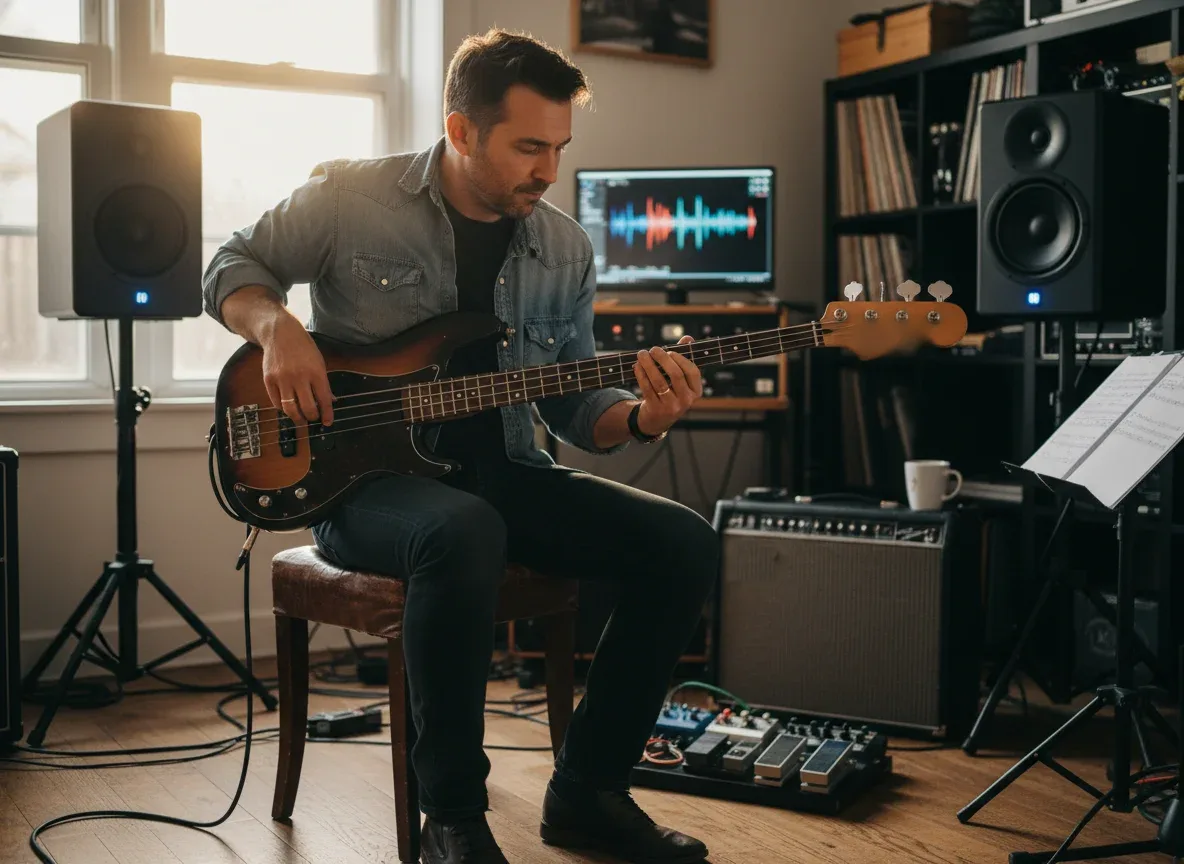
The short answer to what is syncopation: it is a rhythm that moves the emphasis away from the strong beats. Instead of landing where your foot taps, a note hits just before the beat, between beats, or on a beat that is normally weak, while the steady pulse carries on underneath. When people say a part is syncopated, they mean it does this on purpose. That small clash between the pulse you feel and the accents you hear is what gives funk, jazz, reggae, Latin music, hip hop and most modern pop their sense of push and bounce.
Strong beats and weak beats come first
You can only move an accent off the beat if there is a beat to move it from. In 4/4 time, the most common meter, each bar has four beats, and they are not equal:
- Beat 1 is the strongest. It marks the start of the bar.
- Beat 3 is the next strongest.
- Beats 2 and 4 are weaker.
- The spaces between the beats are weaker still.
To see those spaces, count every beat in four parts: "1 e & a, 2 e & a, 3 e & a, 4 e & a" (say it "one ee and uh"). The numbers are the beats, the "&" falls exactly halfway between them, and the "e" and "a" are the quarter points. Each syllable is one sixteenth note, so a bar of 4/4 has 16 of them.
The tables in this post write rhythms on that count. Each column is one sixteenth note, an x is a hit (as in drum tabs) and an empty cell is silence. A kick drum on every beat looks like this:
| 1 | e | & | a | 2 | e | & | a | 3 | e | & | a | 4 | e | & | a | |
|---|---|---|---|---|---|---|---|---|---|---|---|---|---|---|---|---|
| Kick | x | x | x | x |
That rhythm is not syncopated at all. Every hit lands on a number.
What makes a rhythm syncopated
A rhythm becomes syncopated when its accents land on the weak parts of that grid, or when it skips a strong beat you were expecting. Three things are needed:
- A steady pulse, either played by the band or just felt by the listener.
- Accents, longer notes or louder notes placed away from the strong beats.
- Enough of the pulse kept elsewhere that you still feel where the beat is.
The third point matters. If every part moved off the beat at once, your ear would simply hear a new beat. Something, often a kick drum, a hi-hat or the listener's own foot, has to hold the original pulse.
Five common types of syncopation
Off-beat accents
The simplest kind puts the hits on the "&" instead of the numbers. In this house-style pattern, the kick keeps the pulse on every beat while an open hi-hat plays every off-beat:
| 1 | e | & | a | 2 | e | & | a | 3 | e | & | a | 4 | e | & | a | |
|---|---|---|---|---|---|---|---|---|---|---|---|---|---|---|---|---|
| Kick | x | x | x | x | ||||||||||||
| Open hat | x | x | x | x |
Sixteenth-note syncopation goes one step further and uses the "e" and "a" spots, which feel even more off balance.
Anticipation, or the push
An anticipation is a note that arrives early. A chord or bass note that belongs on beat 1 of the next bar lands on the "&" of 4 instead, then rings through the bar line. Musicians call this a push. It makes the music sound eager, as if it is leaning forward.
Ties across the beat
A note starts on a weak spot and is held through the next strong beat, so that beat gets no new attack. A classic example over two beats is short, long, short: a hit on 1, a hit on the "&" that is held through beat 2, then a hit on the "&" of 2. Counted in eighth notes:
| 1 | & | 2 | & | |
|---|---|---|---|---|
| Note | x | x | held | x |
Beat 2 still passes in your head, but nothing new sounds on it. In sheet music this is often written as an eighth note, a quarter note and another eighth note, or with a tie across the beat.
Rests on strong beats
Leaving a strong beat empty is just as powerful as hitting a weak one. You feel the missing beat 1 because you expected it. Reggae's one drop style is a well-known case: the kick drum skips beat 1 and lands only on beat 3.
| 1 | e | & | a | 2 | e | & | a | 3 | e | & | a | 4 | e | & | a | |
|---|---|---|---|---|---|---|---|---|---|---|---|---|---|---|---|---|
| Kick | x |
Three against two, and the 3 + 3 + 2 feel
Some syncopation comes from grouping notes in threes against a pulse that moves in twos. A true three against two plays three even notes in the time of two beats. A close cousin splits eight eighth notes into groups of three, three and two, which puts hits on 1, the "&" of 2, and 4. Counted in eighth notes:
| 1 | & | 2 | & | 3 | & | 4 | & | |
|---|---|---|---|---|---|---|---|---|
| Hits | x | x | x |
That 3 + 3 + 2 figure runs through Latin American, Caribbean and African styles, and through a lot of pop and hip hop that borrows from them.
Syncopation in different genres
- Funk. The band locks onto the sixteenth-note grid. The bass and kick hit the "e" and "a" spots, the guitar plays short, choppy notes, and then the whole band lands hard together on beat 1. That shared downbeat is what lets everything else move around.
- Jazz. Horn lines and piano chords accent the off-beats and push into the next bar, all on top of swung eighth notes. A steady ride cymbal and walking bass hold the pulse.
- Reggae. Guitar and keys chop short chords on the off-beats, often called the skank, while the drums may leave beat 1 empty in the one drop style.
- Latin. The clave, a two-bar pattern of five strokes, sets the rhythm for much of Afro-Cuban music. The son clave is written out in the table below. Salsa bass lines often skip beat 1 entirely and land on the "&" of 2 and on 4.
- Reggaeton. The dembow keeps a kick on every beat while the snare plays off the beat, on the "a" of 1, the "&" of 2, the "a" of 3 and the "&" of 4.
- House. The four-on-the-floor kick is not syncopated, but the open hi-hat on every "&" is. That off-beat hat over a straight kick is the core of the style.
- Hip hop, trap and Afrobeats. Kicks and 808s land between the beats, and drill is known for sliding 808s and triplet hi-hats. One common Afrobeats kick pattern hits on 1, the "a" of 2 and the "&" of 3.
Here are the reggaeton dembow (the Kick and Snare rows) and the son clave on the same sixteenth-note count. In the dembow, counting from the kick on 1, the snare hits in each half bar fall 3, 3 and 2 sixteenths apart: the same 3 + 3 + 2 idea, squeezed into half the time. The clave normally spans two bars of eighth notes; here it is squeezed into one bar so it fits the grid.
| 1 | e | & | a | 2 | e | & | a | 3 | e | & | a | 4 | e | & | a | |
|---|---|---|---|---|---|---|---|---|---|---|---|---|---|---|---|---|
| Kick | x | x | x | x | ||||||||||||
| Snare | x | x | x | x | ||||||||||||
| Clave | x | x | x | x | x |
How to count and clap syncopated rhythms
Practice slowly, out loud, with something keeping the beat for you.
- Open the BPM Tapper, tap at least 4 times on Tap here at a slow, comfortable speed, then switch on Metronome. It clicks at the tempo you tapped, and you can nudge it up or down by 1 BPM.
- Tap your foot on every click and count "1 e & a, 2 e & a" out loud.
- Clap only on the "&". Your foot stays on the numbers and your hands go between them.
- Switch to counting "1 & 2 & 3 & 4 &" and clap the 3 + 3 + 2 pattern from earlier: on 1, on the "&" of 2 and on 4.
- Leave out beat 1: stay silent on 1 but clap 2, 3 and 4. Feel the gap rather than rushing into it.
- Only speed up once the clapping feels steady.
Build a syncopated beat in a step sequencer
A step sequencer shows the grid from this post on screen. The Random Beat Generator runs in your browser, with no sign-in and no credits. It has six drum rows and 16 or 32 steps, and the steps are grouped in fours under the beat numbers. In each group the first cell is the beat itself, and the cells after it are the "e", the "&" and the "a".
- Under Genre, choose House and press Play. Look at the Open hat row: it hits the "&" of every beat.
- Switch to Reggaeton and find the dembow in the second row, the snare row, playing off the beat against a kick on every beat.
- Press Randomize a few times. Each genre keeps its skeleton, like the house off-beats, the four-on-the-floor kick and the dembow, and the other hits are added or removed by chance. It is neither fully random nor fully manual.
- Set Tap to to Add or remove and click cells yourself. Add a Kick on the last cell before beat 3, or clear one from beat 1, and listen to how the groove shifts.
- Try the Swing control. At 50% the grid is straight; higher values delay every second sixteenth for a looser, triplet-like feel. It changes timing, not where the accents fall.
- Press Download WAV to keep the loop. The sequencer does not save your pattern, so download it before you close the tab.
If you want the beat to grow into a full track, Make it a full track with AI writes a prompt from your genre, tempo and key and sends it to the song generator. It does not use your exact pattern or your WAV.
Ask for syncopation in an AI prompt
You can also describe the rhythm you want in words. On the AI Beat Maker, the Funk Music Generator or the Jazz Music Generator, type into Describe your song and name the syncopated parts:
- "Tight funk groove with syncopated slap bass, choppy rhythm guitar and horn stabs on the off-beats"
- "Small jazz combo with swung ride cymbal, piano comping on the off-beats and pushed horn hits"
- "Reggaeton instrumental with dembow drums, deep sub bass and off-beat synth plucks"
Turn on Instrumental if you do not want vocals, then press Create instrumental. Each run gives you Version 1 and Version 2 to compare. Words like "syncopated" or "off-beat" often shape the groove, but there is no guarantee a specific rhythm comes out, and you cannot place a hit on an exact step this way. When you need that control, use the sequencer. The main AI music generator takes the same kind of prompt for any style.
FAQ
What does syncopated mean?
Syncopated means the accents fall on unexpected parts of the beat, such as off-beats or weak beats, instead of the strong beats. A syncopated rhythm still sits on a steady pulse; it just plays against it.
Is syncopation the same as an off-beat rhythm?
Not quite. Off-beat accents are one type of syncopation. Syncopation also includes anticipations, notes tied across the beat, rests on strong beats and 3 + 3 + 2 groupings.
Is swing the same as syncopation?
No. Swing changes the timing of the in-between notes, making pairs of eighth notes long and short. Syncopation changes where the accents land. Jazz often uses both at once, which is why they get mixed up.
Is a backbeat on 2 and 4 syncopation?
A snare on beats 2 and 4 does accent the weaker beats, and some teachers call it a mild form of syncopation. It is so standard in pop and rock, though, that most musicians just call it the backbeat and save the word syncopation for rhythms that feel more off balance.
Can a melody be syncopated?
Yes. Singers often place a word just before the beat, on the "&" of 4 or the "a" of a beat, so the line feels conversational. Pop, R&B and hip hop vocals do this all the time.